
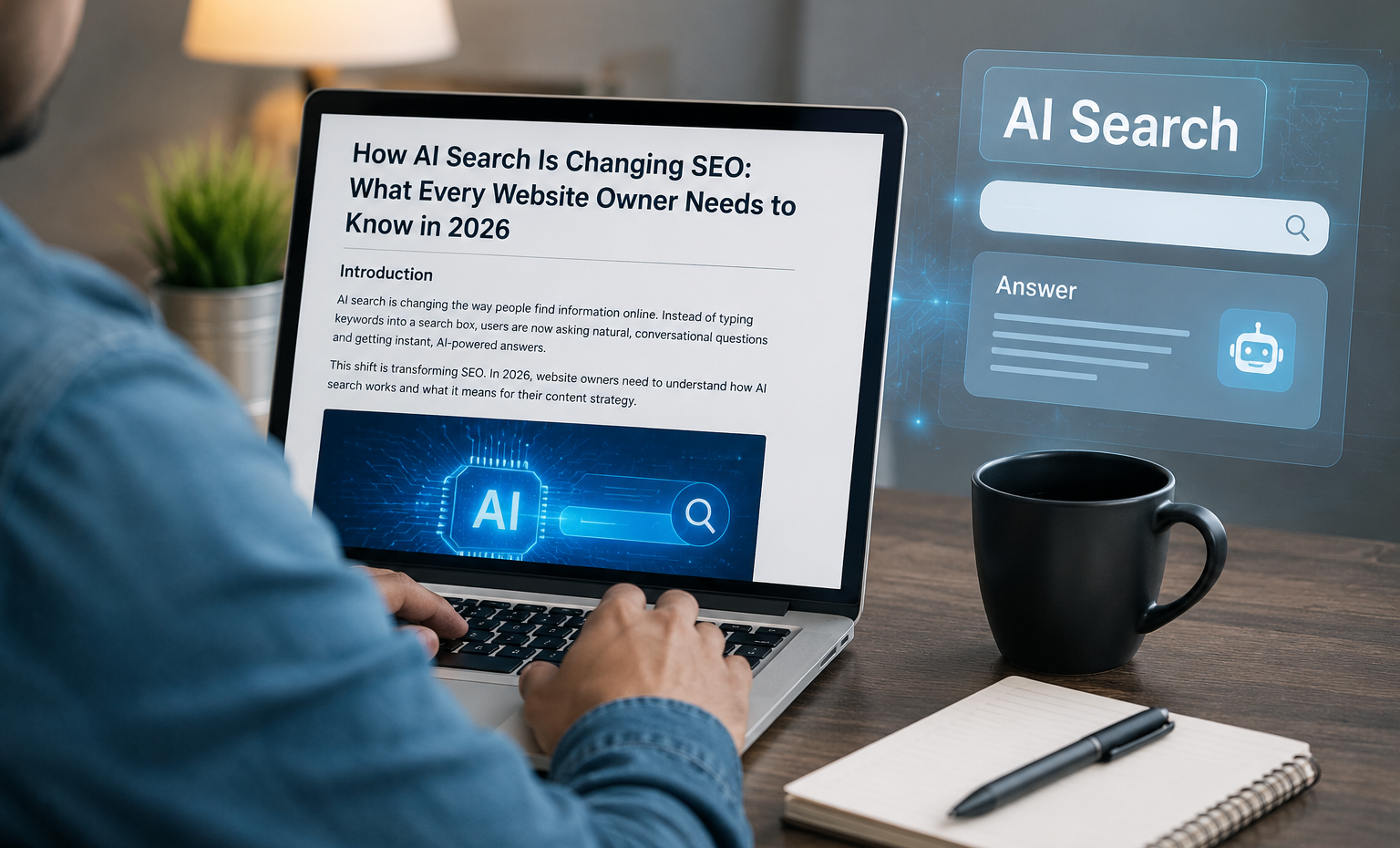
How AI Search Is Changing SEO: What Every Website Owner Needs to Know in 2026
The paper’s primary analysis revolves around the relationship between AI search and SEO. In conventional search, users need to open a browser, launch the search engine, and type the query. Modern searchers interact with chatbots and assistants; the user experience is more natural and conversational. Users will ask questions to their smart devices and expect instant answers by 2026.
The Current State of AI Search and SEO
This analysis serves as the foundation for the following discussions. The current state of AI search establishes the primary content creation standards. In 2026, SEO will prioritize high-quality, high-value, and reliable content. The traditional ranking factor, keyword stuffing, is obsolete. As AI changes the search paradigm, website owners need to understand that search is no longer about keywords and learn to adapt to these changes.
The prevailing narrative in the SEO industry is that AI will eliminate the need for SEO. Some argue that AI will redefine the industry, urging it to transition towards practical content creation that is easily readable by AI assistants. AI search refers to the new generation of search technologies that utilize machine learning and natural language processing algorithms to enhance search accuracy. This technology eliminates the limitations of conventional search in keyword-centric matching. AI search understands the intent behind the search query and evaluates the quality of search results by cross-referencing information with additional context. It produces synthesized answers as opposed to a list of relevant web pages and provides accurate conversational responses, enabling users to instantly obtain the desired information without sifting through multiple search results.
How AI Search Is Changing SEO
As explained by the title of this article, How AI Search Is Changing SEO , AI-powered search engines are gradually transforming the SEO landscape. While keywords remain an important ranking factor, SEO is no longer keyword-centric. The new SEO paradigm prioritizes satisfying the intent behind the search query; the following sections will explore how AI affects SEO. The two significant improvements to AI search create two critical constraints for content creation on the internet. First, the technology can directly answer questions, which means content creators must provide value upfront. Second, the technology can accurately identify the intent behind the search query, which means content creators must adhere to specific guidelines when publishing online content.
Four Fundamental Requirements for Website Owners
This paper suggests that website owners and content creators must adhere to four fundamental requirements when operating websites in the AI search era. First, they should focus on creating high-quality and original content. Websites should provide reliable and professional information that appeals to AI search engines. Second, content should be structured in a manner that search engines can easily parse and read. Third, the emphasis on authority has increased significantly in the AI era; therefore, website owners should strive to improve their E-E-A-T. Finally, the website should provide an exceptional user experience by facilitating rapid access to information.
Why Is Search Intent More Important Than Ever?
Website owners must abandon the idea of manipulating the system and begin delivering value to their audiences. Why is search intent more important than ever? Search intent refers to the underlying motivation that determines what a user is looking for. Modern AI search engines can recognize the intent behind the search query. For instance, users searching for “definition of AI” expect a succinct and comprehensive definition of the term. In contrast, users searching for “how to train a dog” are looking for practical and actionable steps on training a dog. On the other hand, users searching for the “best AI SEO tools 2026” are in the research phase and, therefore, looking for product reviews.
Generative Engine Optimization (GEO)
When creating content that satisfies these search intents, content creators should adhere to specific guidelines. This paper recommends Generative Engine Optimization (GEO), which is specifically designed for AI search engines. Unlike traditional SEO, which focuses on improving a website’s ranking on search engines, GEO aims to enable search engines to comprehend, summarize, and recommend the content, which must meet four primary requirements: clarity, accuracy, formatting, and directness. A GEO-compliant article should have clear subheadings and headings, short paragraphs, direct answers to questions, unique perspectives and case studies, FAQs, reliable and factual information, and keyword usage.
Content Quality in the AI Search Era
When combined with SEO best practices, this guideline will ensure that content satisfies both search engines and AI assistants. In the AI search era, content quality has become the most critical ranking factor. Professional and original content based on experience is the cornerstone of SEO. The primary objective of creating high-quality content is to satisfy both users and search engines. Content creators should adhere to six essential principles in creating such content. First, they should focus on addressing the pain points of their target audience. Second, they should strive to create comprehensive and easy-to-read content. Third, they should avoid using redundant verbiage. Fourth, they should leverage case studies and real-world examples. Fifth, they should update their content on a regular basis. Finally, they should use descriptive subheadings to break down their content.
E-E-A-T and Technical SEO
Search engines, including those powered by AI, use the E-E-A-T (Experience, Expertise, Authoritativeness, Trustworthiness) framework as a standard for evaluating content. Therefore, content creators should adhere to the following five recommendations to improve their E-E-A-T: publish reliable information based on extensive research, disclose professional qualifications, update content on a regular basis, cite credible sources, and share first-hand experience. In the AI era, technical SEO remains critical to a website’s success. At the critical juncture of AI search in 2026, this paper provides six fundamental technical requirements for website owners to consider when optimizing their sites for AI search engines. Some of the compliance areas include responsive design and structured data.
How to Optimize Your Website for AI Search
Website owners should complete this self-assessment before proceeding to the next section on How to Optimize Your Website for AI Search . This paper provides eight recommendations for creating high-quality content that adheres to search engine standards and satisfies users. First, content should directly answer the questions of the target audience. Second, the content should have clear titles that search engines can parse and read. Third, the content should use a natural conversational style that is appropriate for chatbots and assistants.
Fourth, the article should define jargon and other technical terms to make it easy for the public to understand. Fifth, the content should have introductory and concluding paragraphs that succinctly summarize the main ideas. Sixth, the content should be completely original and provide exclusive information and research data. Seventh, website owners should update their older content on a regular basis. Eighth, they should conduct extensive research on related topics to expand their expertise in a particular niche.
Common SEO Mistakes
In the following section, this paper will review the most common mistakes that website owners make that hinder their search engine optimization efforts. At present, the SEO industry has seven major non-compliant and low-quality practices. First, website owners engage in keyword stuffing to boost their rankings. Second, they publish low-quality duplicate content. Third, they use clickbait false headlines to entice users to visit their websites.
Fourth, they publish unverified information. Fifth, they ignore the needs of their target audience. Sixth, they rely solely on AI-generated content without human intervention. Finally, they disregard technical SEO and website structure optimization. The author contends that SEO will continue to exist in the AI era; it will only evolve. Entities that employ a combination of technical SEO, user-centric content, and generative engine optimization while adhering to quality, transparency, and user experience guidelines will thrive in the new environment.
FAQs
What is AI search?
It is a new search engine that leverages artificial intelligence to understand the intent behind the search query and extract information from authoritative sources to provide conversational answers.
How will AI search change search engine optimization (SEO)?
It has redefined the fundamental principles of SEO, placing greater emphasis on content quality, relevance, originality, and E-E-A-T while devaluing keyword-centric practices. SEO is transitioning from single-keyword optimization to enhanced user experience and high-quality content creation.
What is GEO in the field of SEO?
It is short for Generative Engine Optimization. It entails creating content in a manner that enables generative search engines to effectively summarize and recommend the information.
Will traditional SEO still be important in 2026?
Yes, it will continue to be relevant but will require additional strategies to comply with the new search engine requirements. Many people ask how to optimize websites for AI search. Some of the most efficient strategies include creating original content, utilizing clear titles, implementing structured data, enhancing authority, and updating content regularly.
Will AI-powered search replace Google’s traditional search?
Many people ask: Will AI-powered search replace Google’s traditional search? Of course, it will not. The two technologies are designed for different purposes and, therefore, complement each other.
Why is search intent critical to search engine optimization (SEO)?
It enables search engines to understand the precise information that users are looking for. Content that satisfies search intent is more likely to rank higher on search engines and be recommended by AI assistants, making it the cornerstone of SEO.
Can AI-generated content obtain search engine rankings?
Yes, it can, but it must meet five fundamental requirements and three implementation standards, including manual review.
Artificial intelligence is gradually transforming how the general public searches for information online. For website owners, this development means that their content must satisfy not only traditional search engines but also AI assistants. The core principle that will ensure success in the new environment is value, clarity, and professionalism. Only then can operators sustain and enhance their presence in the traditional and AI-driven search engine landscape.
Author Bio
Nitesh Singh is a professional content writer with expertise in SEO, AI, Digital Marketing, Technology, Agriculture, Tractor, Health, and Lifestyle content. He specializes in creating original and well-researched articles that are optimized for traditional and AI search engines.
