
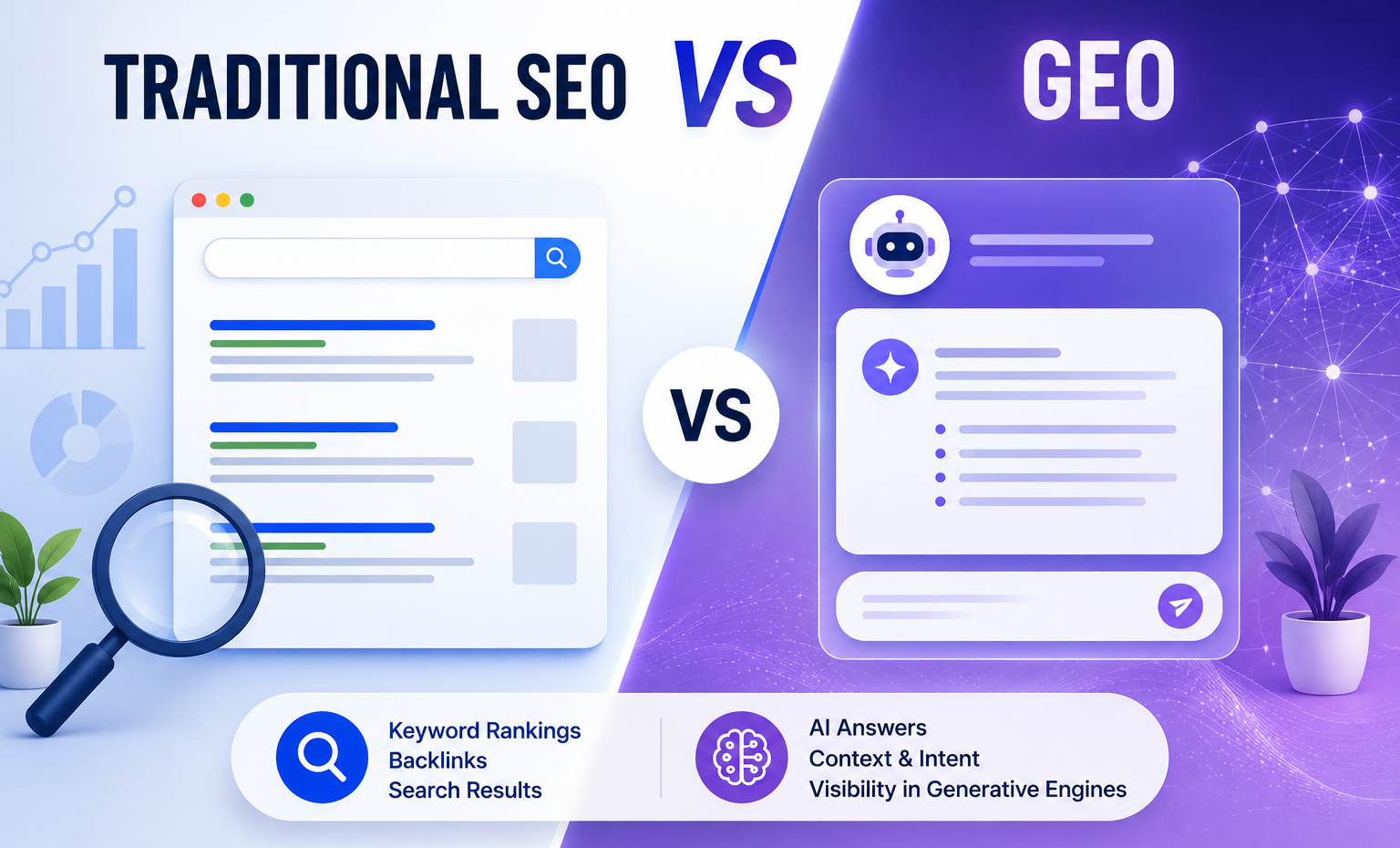
GEO vs Traditional SEO: Key Differences
A client asked me last month why her rankings looked fine but her traffic had quietly dropped 20% over six months. Nothing had changed on her site. No algorithm penalty, no technical issue, nothing her SEO dashboard was flagging.
Turns out a good chunk of her audience was still finding answers, just not on her page anymore. They were getting them straight from ChatGPT or a Google AI Overview instead, and her site never got the click.
That’s the shift behind GEO, or Generative Engine Optimization. It’s not a buzzword agency invented to sell new packages, though plenty are doing exactly that right now. It’s a genuine response to how people search in 2026, and if you’re still measuring success purely by rankings, you’re only seeing half the picture.
Traditional SEO, the short version:
You know this one already if you’ve been in marketing for more than a year. Traditional SEO means getting a page to rank on Google for a term someone types in, and it usually comes down to the same handful of moving parts:
- Keyword research, so you know what people are actually typing into Google
- On-page work, things like title tags, headers, and internal linking
- Backlinks, which still do a lot of the heavy lifting for authority
- Technical fixes, page speed, mobile-friendliness, broken links, indexing issues
- Content that’s genuinely useful, not just stuffed with the target phrase
Then you wait. Sometimes months. Success looks like moving from page three to page one, or finally beating that one competitor who’s ranked above you since 2022.
It’s still a numbers game built around one metric really: did someone click your link. A business selling small business SEO services lives or dies by whether it shows up when a shop owner searches “SEO help near me” at 11pm, half-panicking because their website hasn’t had an enquiry in three weeks.
The tools and tactics here are mature at this point. Everyone knows what a title tag should look like, what a healthy backlink profile looks like, how to structure an H1 and H2. None of that goes away with GEO. It’s just no longer the whole story, and Neil Patel’s breakdown of GEO vs SEO is a good place to see why that split has started to matter so much.
So what’s actually different about GEO?
Here’s the part that trips people up. GEO isn’t about ranking at all, and it changes a few things at once:
- It’s about getting mentioned inside the answer an AI gives, before the person ever sees a list of links, or sometimes without a list of links appearing at all
- Ask ChatGPT which agency offers the best ecommerce SEO services in India, and it won’t hand back ten blue links. It’ll name two or three brands directly, pulled together from whatever sources it trusts most on that topic. If your business isn’t one of them, you don’t exist in that conversation at all, no matter how well you rank on Google for the same term
- Search Engine Land put it well when they described GEO as sitting alongside SEO rather than replacing it. GEO doesn’t undo years of SEO work, it builds on top of it, or in some cases ignores it entirely and starts fresh, depending on how the original content was written and how easy it is for an AI system to lift a clean answer out of it
- There’s also a measurement problem nobody’s fully solved yet. You can check your Google ranking any time you like. Checking whether ChatGPT or Gemini is citing your brand means manually asking the questions yourself, across different platforms, and even then you’re only seeing a snapshot
That’s a strange thing to sit with if you’ve spent years chasing position one, and it matches what I’m seeing with clients too.
Where do they actually differ?
| Traditional SEO | GEO | |
| What you’re chasing | A ranking position | A mention inside the AI’s answer |
| How you know it’s working | Traffic, position, clicks | Whether AI tools cite you at all |
| Writing style | Long, keyword-heavy pages | Short, direct, quotable answers |
| Timeline | Slow, months to move | Faster to shift, but needs constant updates |
| What builds trust | Backlinks, domain age | Mentions across the web, clear structure, real expertise |
| Where it shows up | Google, Bing | ChatGPT, Perplexity, Gemini, AI Overviews |
Neither column cancels the other out. Most businesses need both running at once now, not one or the other.
Do keywords even matter anymore:
Yes, just not in the way they used to. Keywords like “ai seo services” or “best digital marketing agency in India” still tell you what people are typing. What’s changed is what happens after that. Stuffing the phrase in five times doesn’t help you get cited. Answering the question clearly, in the first couple of lines, does.
I’ve watched this play out with a few of our own pages. The ones written to answer a specific question upfront get picked up by AI tools far more often than the ones that spend three paragraphs warming up before getting to the point. It’s almost the opposite of how a lot of SEO content was trained to open, with a long introduction before the actual answer shows up somewhere in paragraph four.
Where do most businesses go wrong with this?
The biggest mistake I see is treating GEO as a technical checklist rather than a writing problem. Businesses add schema markup, tidy up their sitemap, tick every technical box, and then wonder why nothing changes. The content itself is still written the old way, dense, keyword-stuffed, answer buried halfway down the page. None of the technical work matters if an AI system can’t easily pull a clean, self-contained answer out of your writing.
The second mistake is chasing GEO while letting basic SEO slide. That’s backwards. Most AI systems still lean heavily on well-ranking, well-established pages when deciding what to cite. If your site has thin authority and patchy technical health, GEO work sits on a shaky foundation.
And the third, probably the most common one, is doing nothing at all because it feels too new to bother with yet. Reasonable instinct, until you remember plenty of businesses said the same thing about mobile optimisation a decade or two back.
What does this mean for how you write?
A few things I’d genuinely change if I were rewriting old content today:
- Put the answer near the top. Don’t make people, or AI, scroll to find it
- Write headers as actual questions. That’s closer to how people type into a chatbot anyway
- Use real numbers and named examples instead of vague claims
- Keep paragraphs tight enough that a whole answer could be lifted out and still make sense on its own
- Go back and refresh old posts. AI tools lean toward recent content when picking sources, and a page that hasn’t been touched since 2023 is easy to skip over
None of this is complicated. It reads more like a well-written FAQ than a stuffed 2,000-word article built around one keyword. If anything, it’s a return to simpler writing, just answer the question, back it up, move on.
Does this matter for businesses in India specifically?
More than most people realise. Search habits here are moving the same direction as everywhere else, just maybe a step behind. More voice search, more people asking an AI assistant a question before ever opening Google, and that behaviour is showing up in tier two and tier three cities now too, not just among younger urban users the way it did two years ago.
Any best SEO company in India, or best digital marketing agency in India for that matter, that skips this now is going to spend a couple of years catching up later. It’s the same mistake businesses made ignoring mobile a decade back, just with a shorter runway this time, because the pace of AI adoption in search has moved faster than mobile ever did.
Should you drop SEO and just chase GEO:
No, and I’d be suspicious of anyone telling you otherwise. Rankings still bring real traffic, and most AI platforms pull their answers from pages that already rank decently well. GEO sits on top of the same fundamentals SEO has always rewarded, structure, authority, trust. It’s an added layer, not a swap.
Where to start if you’re doing neither well right now?
Look at what you’ve already published before writing anything new. Find the pages answering good questions badly, and fix the opening lines first. Add structured data where it’s missing. Actually go and ask ChatGPT or Gemini something about your own industry and see if your brand comes up at all, most businesses never bother checking this.
WordStream’s guide to GEO and SEO is a decent place to read more if you want the fuller picture before building this into a plan. After that, it’s mostly a matter of treating the two as one connected effort instead of picking sides.
About the Author
Abhay Mirchandani is the Founder of Digifinity, a full-service digital marketing agency helping businesses across India, the USA, and the UK grow through SEO, performance marketing, and digital strategy. He’s passionate about helping brands adapt to the evolving search landscape, from traditional SEO to AI-driven discovery.
